
When it comes to motorcycle safety, most riders immediately think of helmets, jackets and gloves. However, protecting your spine should be just as much of a priority.
Whether you’re a new rider, a seasoned commuter, a long-distance tourer or a dedicated track enthusiast, a quality back protector can significantly reduce the force transmitted to your body in the event of an accident.
With so many options available, choosing the right back protector can be confusing. What’s the difference between CE Level 1 and Level 2? Is a standalone back protector better than a jacket insert? And which model is right for your riding style?
Let’s break it all down.
What Are CE Armour Ratings?
Motorcycle back protectors are tested to the EN1621-2 European safety standard. This certification measures how much force is transmitted through the protector during impact testing. The lower the transmitted force, the better the protection.
CE Level 1
To achieve CE Level 1 certification:
- Average transmitted force must be below 18kN.
- No single impact can exceed 24kN.
- Typically lighter and thinner than Level 2 protectors.
- Often favoured by riders prioritising flexibility and comfort.
CE Level 2
To achieve CE Level 2 certification:
- Average transmitted force must be below 9kN.
- No single impact can exceed 12kN.
- Offers approximately twice the impact absorption capability of Level 1 armour.
- Favoured by riders seeking the highest certified level of spinal protection.
For many riders, Level 2 protection provides additional peace of mind, particularly for sports riding, touring and track use.
Standalone Back Protectors vs Back Protector Inserts
One of the most common questions customers ask is whether they should choose a standalone back protector or a back protector insert.
Standalone Back Protectors
Examples include:
- Knox Microlock Air MKII
- Knox Aegis
- Alpinestars Nucleon KR-1 Cell
- Alpinestars KR-R Cell
- Alpinestars KR-2
- Alpinestars KR-3
- Alpinestars Nucleon Plasma Back Protector With Straps
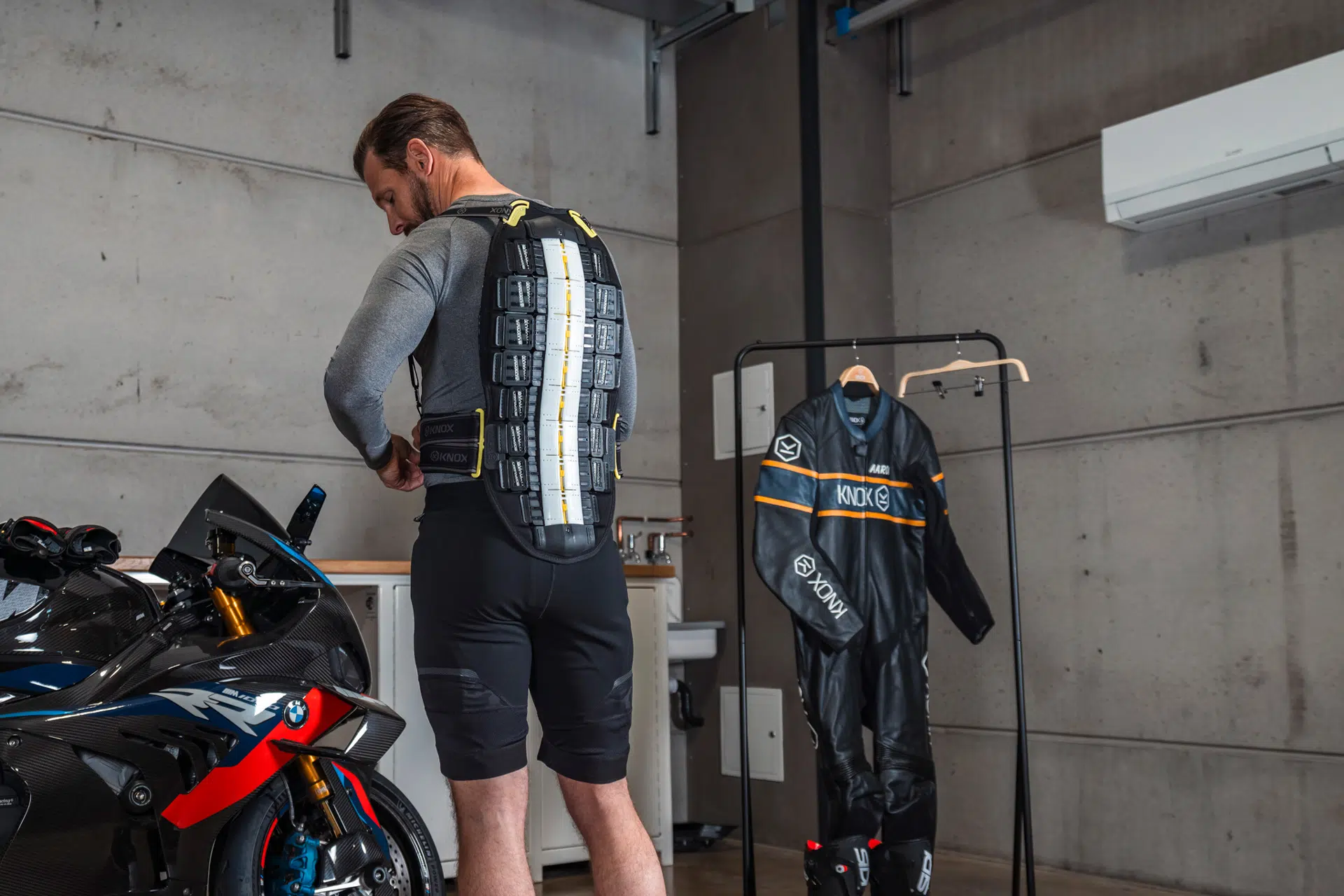
These use shoulder straps and waist belts to hold the protector securely against the body and typically offer greater coverage than inserts.
Benefits of Standalone Protectors
- Greater coverage area
- More secure positioning during a crash
- Adjustable fit
- Can be worn with multiple jackets
- Often preferred by track riders and sports riders
Back Protector Inserts
Examples include:
- Alpinestars Nucleon Flex Proi
- Alpinestars Nucleon Plasma Full Back Protector Insert
- Alpinestars KR-CELLi
- RST x D3O Viper Air
These fit directly into the armour pocket found in many modern motorcycle jackets.
Benefits of Inserts
- Extremely low profile
- Lightweight and comfortable
- No shoulder straps or kidney belts
- Excellent for commuting and everyday riding
- A significant upgrade over standard foam inserts
Why Many Riders Choose a Separate Back Protector
A dedicated back protector such as the Alpinestars Nucleon KR-1 Cell is designed solely around protection and stability. Because it is secured directly to the rider using shoulder and waist straps, it is less likely to move in an impact and often provides larger protective coverage. The KR-1 Cell also features extended lower-back protection and an adjustable kidney belt system.
By comparison, a product such as the Alpinestars Nucleon Flex Proi Back Protector Insert integrates neatly into a jacket and provides excellent protection without additional bulk. Many riders prefer this solution because they simply fit it and forget about it.
The good news is that neither option is wrong—it simply depends on your riding style, comfort preferences and protection priorities.
Popular Motorcycle Back Protectors Explained
| Back Protector | Protection Level | Type / Fit | Best Suited To | Key Features |
|---|---|---|---|---|
| Alpinestars Nucleon KR-CELL Back Protector | CE Level 1 | Standalone protector with straps | Everyday road riding and value-focused protection | Lightweight standalone protector with a perforated construction, ergonomic fit and a strong balance of comfort, protection and value. |
| Alpinestars Nucleon KR-CELLi Back Protector Insert | CE Level 1 | Jacket insert | Simple jacket protection upgrades | Lightweight, easy-to-fit insert designed to improve protection compared with standard foam padding, while remaining comfortable and low bulk. |
| Knox Microlock Air MKII Back Protector | CE Level 2 | Standalone protector with straps | Long-distance touring and everyday riding | Soft and flexible Microlock armour with breathable air channels, double waist straps and optional chest protector compatibility. |
| Knox Aegis Back Protector | CE Level 2 | Standalone protector with straps | Touring and road riding | Proven Knox standalone protector with reliable CE Level 2 protection, a secure fit and strong comfort for regular road use. |
| Alpinestars Nucleon Plasma Back Protector With Straps | CE Level 2 | Standalone protector with straps | Sports riding and touring | Bio-based viscoelastic material, semi-rigid spinal zone, lightweight construction and excellent ventilation for comfort and protection. |
| Alpinestars Nucleon KR-2 Back Protector | CE Level 2 | Standalone protector with straps | Touring and longer rides | Touring-focused protector with articulated vertebrae protection, viscoelastic memory foam, lightweight construction and extensive airflow. |
| Alpinestars Nucleon KR-R Cell Back Protector | CE Level 2 | Standalone protector with straps | Sports and performance riding | Race-inspired standalone protector offering CE Level 2 impact protection, strong airflow and good freedom of movement. |
| Alpinestars Nucleon KR-1 Cell Back Protector | CE Level 2 | Standalone protector with straps | Sports riding, track use and riders wanting extra stability | Hard-shell lattice construction with Cell Technology armour, extended lower-back coverage, removable straps and an adjustable kidney belt. |
| Alpinestars Nucleon KR-3 Back Protector | CE Level 2 | Standalone protector with straps | Serious road, sports and track riders | Premium standalone protector with larger coverage, high-performance protection and strong suitability for track and sports riding. |
| Alpinestars Nucleon Flex Proi Back Protector Insert | CE Level 2 | Jacket insert | Riders wanting a slim protection upgrade inside a compatible jacket | Premium insert combining CE Level 2 protection, flexibility, comfort and impact absorption in a slim, jacket-friendly profile. |
| Alpinestars Nucleon Plasma Full Back Protector Insert | CE Level 2 | Jacket insert | Riders wanting breathable protection inside a compatible jacket | Advanced Plasma insert with excellent airflow, flexible fit and minimal bulk inside compatible Alpinestars jackets. |
| RST x D3O Viper Air Level 2 Back Protector | CE Level 2 | Jacket insert | Riders wanting lightweight, breathable jacket armour | D3O Viper Air technology with CE Level 2 protection, improved ventilation, enhanced flexibility and reduced contact area for comfort. |
Choosing the Correct Size Back Protector
Even the highest-rated back protector can only perform effectively if it fits properly. A poorly sized protector may leave parts of the spine exposed or move out of position during an impact, reducing the level of protection exactly when you need it most.
Whether you’re choosing a standalone back protector or a jacket insert, selecting the correct size is just as important as choosing the right protection level.
Why Correct Sizing Matters
A correctly fitted back protector should:
- Cover the spine from the upper back down towards the tailbone
- Sit centrally between the shoulder blades
- Remain securely in position while riding
- Allow natural movement without restricting comfort
- Stay close to the body without creating pressure points
If a protector is too short, areas of the spine may be left unprotected. If it is too long, it can push against the back of the helmet or become uncomfortable when seated on the motorcycle.
This is one of the reasons many riders prefer dedicated standalone protectors such as the Knox Microlock Air MKII, Alpinestars Nucleon KR-1 Cell or Nucleon Plasma Back Protector With Straps, as the shoulder straps and kidney belts help keep the armour correctly positioned throughout a ride.
How to Measure Yourself for a Back Protector
Most manufacturers size their protectors based on rider height and torso length.
Method 1 – Follow the Manufacturer’s Sizing Guide
This is always the recommended approach, as sizing varies between brands and models. Alpinestars, Knox, RST and D3O all provide model-specific sizing recommendations.
Method 2 – Measure Your Back Length
For the most accurate fit:
- Stand upright in your normal riding posture.
- Locate the prominent bone at the base of your neck (the C7 vertebra).
- Locate the top of your tailbone.
- Measure the distance between these two points.
The protector should ideally cover the majority of this measurement without interfering with your helmet or motorcycle seat.
Method 3 – Consider Your Riding Position
Your riding style can also influence sizing:
Sports and Track Riders
- Often favour maximum coverage.
- May choose larger standalone protectors such as the KR-1 Cell, KR-3 or Knox Aegis.
- Benefit from secure shoulder straps and kidney belts.
Touring Riders
- Usually balance comfort and coverage.
- Commonly choose products such as the Knox Microlock Air MKII or Alpinestars KR-2.
Commuters and Everyday Riders
- Often prioritise convenience and comfort.
- Frequently choose inserts such as the Nucleon Flex Proi, Plasma Full Back Protector Insert or RST x D3O Viper Air.
Jacket Inserts: Don’t Assume One Size Fits All
A common mistake is assuming any insert will fit any jacket.
Back protector inserts are designed to fit specific armour pockets and should always be matched to the manufacturer’s size chart. For example, an Alpinestars Nucleon Flex Proi or Plasma Insert is available in multiple sizes to suit different jacket sizes and back lengths.
Before purchasing an insert, always check:
- Jacket compatibility.
- Recommended jacket size range.
- Protector dimensions.
- CE certification level.
Try It On Before Riding
Once fitted:
- Sit on your motorcycle.
- Adopt your normal riding position.
- Check that the protector does not interfere with your helmet.
- Ensure it remains centred on your back.
- Confirm there are no pressure points when leaning forwards.
If you can comfortably forget it’s there after a few minutes, you’ve probably found the correct fit.
Remember: the best back protector isn’t necessarily the most expensive or the highest-rated. It’s the one that fits you correctly, stays in place during a crash and is comfortable enough that you’ll wear it on every ride.
Final Thoughts
Modern motorcycle armour has come a long way. Today’s back protectors are lighter, more breathable and more comfortable than ever before, whilst offering exceptional levels of impact protection.
Whether you choose a premium standalone protector such as the Knox Microlock Air MKII, Alpinestars Nucleon Plasma Back Protector With Straps or Alpinestars Nucleon KR-1 Cell, or a convenient insert such as the Nucleon Flex Proi or RST x D3O Viper Air, the most important thing is ensuring you’re wearing certified protection every time you ride.
Notably, 10 of the 12 protectors featured in this guide achieve CE Level 2 certification, demonstrating just how accessible top-tier spinal protection has become. For riders who want the highest level of certified back protection without sacrificing comfort, there has never been a better time to upgrade.