
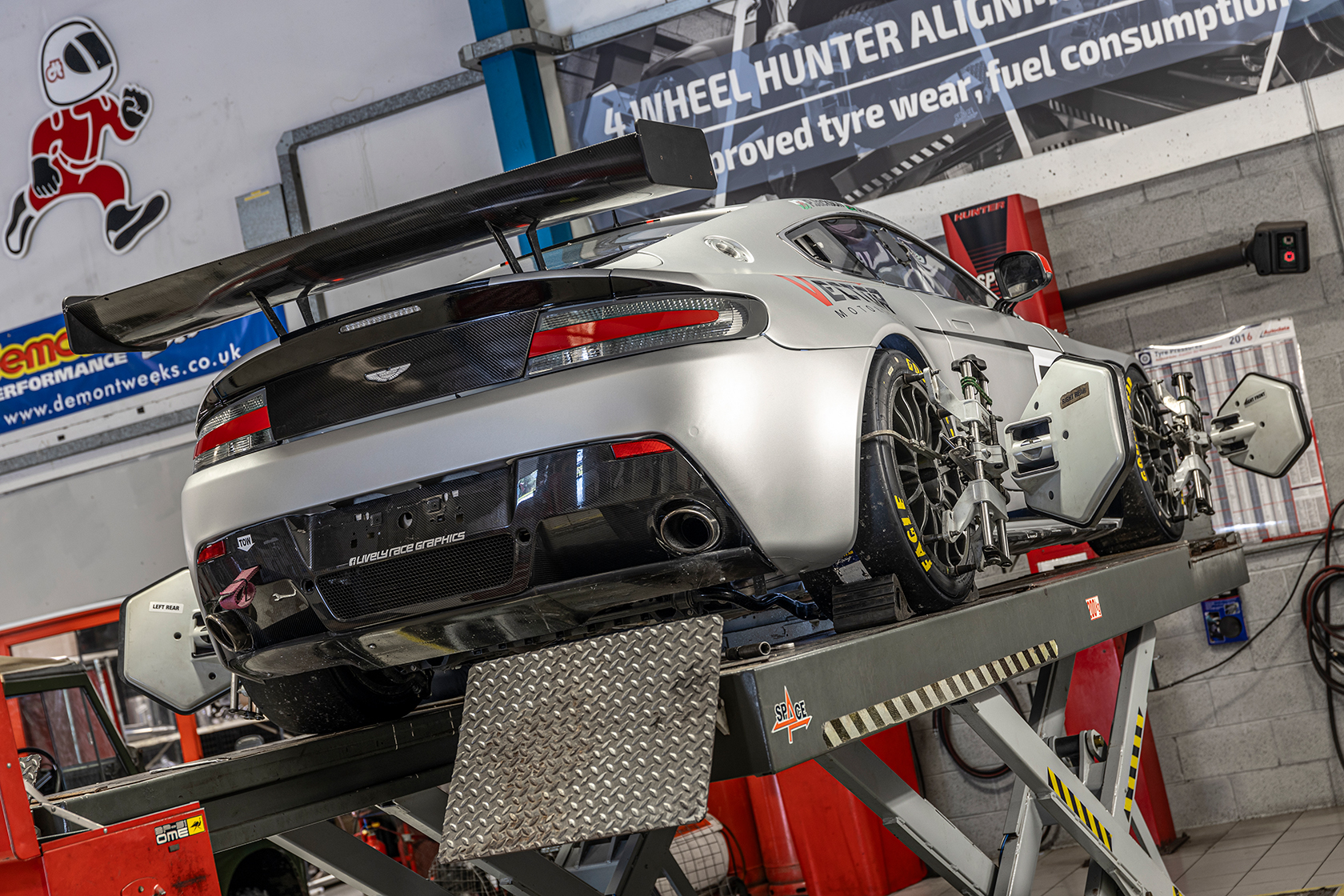
Improving your car’s handling and feel is not only about replacing suspension components, fitting new tyres or reducing weight. These upgrades can all make a noticeable difference, but they will not perform at their best if the car’s wheel alignment is not set correctly.
A proper four-wheel alignment is one of the most cost-effective ways to get more from the suspension and tyres already fitted, whether the car is used on the road or track.
However, there is no single alignment setup that is optimised for every car, or every driver. A daily-driven road car, a fast-road car used for weekend B-road bashing, an occasional track-day car and a dedicated race car will all have different priorities.
For some drivers, the focus will be stability, tyre life and predictable handling for everyday use. Others may want sharper turn-in, stronger front-end grip, or more consistency over repeated laps. Many performance car owners will sit somewhere in the middle, wanting a setup that feels more responsive when the car is pushed, without becoming unsteady or impractical on the road.
This guide explains the key alignment angles, how fast-road, track-day and race setups differ, and how our in-house Hunter four-wheel alignment system helps apply tailored geometry settings accurately.
Why wheel alignment matters
The alignment of your car’s wheels has a direct effect on how it feels and responds. It influences how the tyres meet the road, how steering reacts, how stable the car feels under braking and how evenly the tyres wear over time.
For a standard road car, poor alignment might be noticed through uneven tyre wear, an off-centre steering wheel, or the car pulling to one side. On a modified or performance road car, those issues can become even more noticeable. Extra grip, firmer suspension, lower ride height and harder driving can all make small alignment problems more pronounced.
A well-set alignment helps the car feel more predictable and helps the car feel more predictable when pushed harder. It can improve turn-in, straight-line stability and braking control, whilst also helping the tyres be used more evenly.
The key alignment angles explained
For everyday road driving, factory alignment settings are usually designed to balance stability, predictable handling and even tyre wear. On a modified or performance car, especially one with upgraded suspension, tyres or chassis components, more focused geometry settings can help the car feel sharper, more stable and more responsive.
Unlike wheel tracking, which usually only inspects the direction the front tyres are facing, a wheel alignment is a comprehensive four-wheel check of the car’s geometry. It focuses on each of the three main angles – camber, caster and toe.
Camber
Camber is the inward or outward tilt of the tyre when viewed from the front of the car.
- Positive camber: The top of the tyre tilts outward away from the vehicle. This is rarely used on modern cars, but can be found in specialist applications where steering effort, load or surface conditions are different.
- Negative camber: The top of the tyre tilts inwards towards the centre of the car. This can help maintain tyre contact and improve cornering grip as the car loads up through a turn.
Caster
Caster is the forward or backward angle of the steering axis when viewed from the side of the vehicle. It affects steering feel, straight-line stability and how naturally the steering returns to centre after a turn.
- Positive Caster: Can improve stability and self-centring, making it useful in performance-focused setups where adjustment is available.
- Negative Caster: Can make steering feel lighter, but usually reduces high-speed stability and is rarely desirable for fast-road or track use.
Toe
Toe refers to the direction the wheels are pointing when viewed from above the car. It has a major effect on steering response, stability and tyre wear.
- Toe-in: The front of the wheels point slightly towards each other. This can improve straight-line stability and make the car feel more settled.
- Toe-out: The front of the tyres point away from each other. This can sharpen initial turn-in, but too much can destabilise the ride and increase tyre wear.
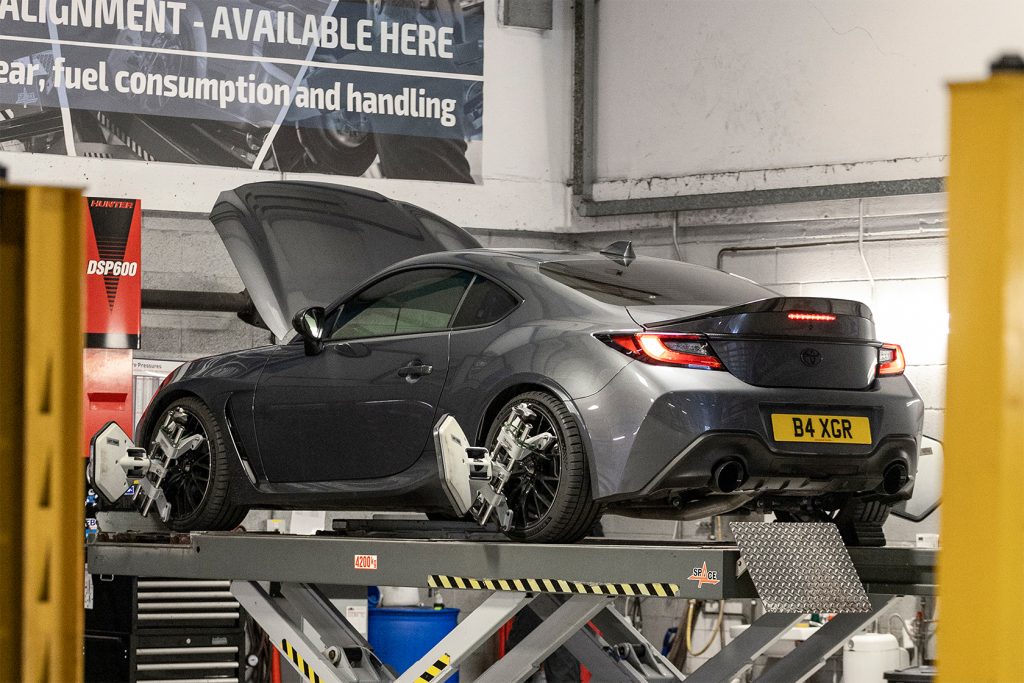
Fast road, track day and race alignment: How priorities change
When it comes to a fast-road setup, where road usability still needs to be retained, the key focuses are usually to sharpen steering response and cornering confidence. But you’re looking for balance – so you need to find a setup that won’t sacrifice stability, tyre life or day-to-day usability. A fast-road setup still needs to behave properly on uneven surfaces, motorway journeys, wet roads and under braking. The geometry therefore usually remains relatively conservative compared with track settings.
Where do you take it from a fast road setup? This is where a track-day focus steps in. This setup can be a much more performance-focused compromise, remembering that the car will likely still see a decent amount of public road commuting. Here, the focus can shift further towards sharper turn-in, stronger front-end grip, maintaining tyre contact during cornering and consistency over repeated laps. Where adjustment allows, more focused camber and toe settings can be used. But, you’ll always need to weigh up on-track performance with tolerable road usability.
Now to take things further, with a dedicated race alignment. This is where the setup can become much more specialised, as you won’t need to factor in road usability. Comfort and tyre longevity become less important, while lap time, consistency and the requirements of a specific car, tyre, circuit or championship become the priority. This is also where things such as corner weighting, tyre temperatures and more extensive suspension adjustment can become relevant.

Remember: There is no single alignment setup that suits every vehicle or type of driving. The right settings will depend on the car, suspension, intended use and how much compromise is accepted. A more aggressive alignment is not automatically better. Too much negative camber or unsuitable toe can reduce braking stability, increase tyre wear or make a road-driven car nervous.
When should you get a four-wheel alignment?
Alignment isn’t only something to seek once your car is pulling to one side, for example. Here are some of the main situations where it is beneficial to have your wheels re-aligned:
- After fitting coilovers, springs, dampers, adjustable arms, bushes, top mounts or other suspension components.
- After significant work involving steering or suspension components.
- When fitting new tyres, particularly if the previous set showed uneven wear.
- If the car develops symptoms such as an off-centre steering wheel, pulling, instability, unusual steering response or uneven tyre wear.
- Before or after making the jump into track use, particularly if the car has recently had chassis or suspension work.
- Periodically on a performance car that gets driven hard, as potholes, kerbs and general use can knock geometry away from where it was originally set.
This is why alignment should be treated as part of the setup, not just a final check.The right geometry can make a noticeable difference to how the whole car performs and how effectively its suspension and tyres are being used.performs.
Demon Tweeks Hunter four-wheel alignment
At our Wrexham fitting centre, we offer four-wheel alignment using our state-of-the-art Hunter rig.
The Hunter four-wheel alignment system allows the geometry to be accurately measured and adjusted, but the real value is that the settings can be selected around the car and intended use rather than blindly applying one generic performance setup.
Depending on the vehicle and available adjustment, the Hunter system can be used for:
- Standard road geometry for cars that simply need returning to manufacturer settings.
- Fast-road/performance geometry where suitable adjustments can sharpen the setup while retaining road usability.
- Track or race-focused settings, where the vehicle allows those adjustments.
- Customer-requested settings, where someone already has a preferred or proven geometry setup for their particular car.
If you are already making use of our fitting centre for suspension changes, new tyres or other chassis work, it is also worth considering four-wheel alignment as part of the overall setup.
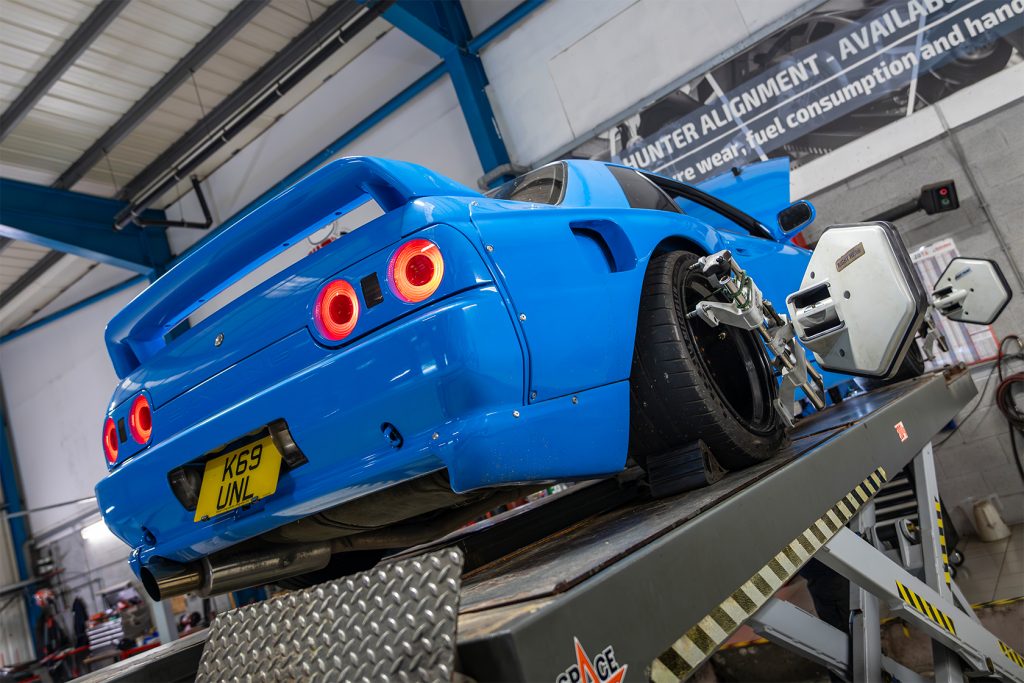
Final Thoughts
Suspension, tyres and chassis upgrades can all change how a car behaves, but their full benefit depends on the geometry being set correctly. Four-wheel alignment brings those components together, helping the car respond as intended rather than simply relying on the parts fitted.
Whether you are refining a fast-road car, preparing for more regular track days or developing a dedicated competition car, the alignment should reflect the vehicle, its components and how it will actually be used. Getting that setup right can make a noticeable difference to steering response, consistency and overall confidence behind the wheel.
If you wish to speak to the experts, you can email sales@demon-tweeks.com or call 01978 664555
For Fitting Centre booking enquiries, email fittingcentre@demon-tweeks.com or call 01978 667909